
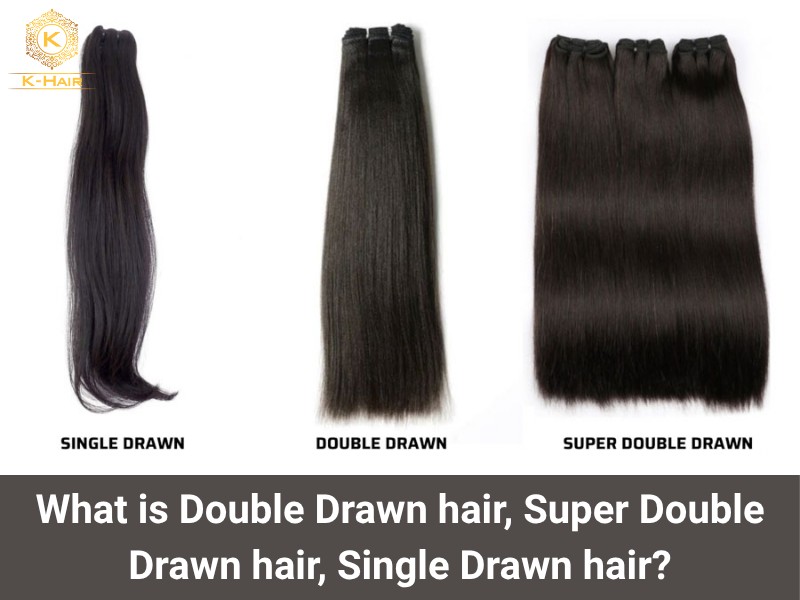
SDD meaning: SDD stands for Super Double Drawn, a hair density grade where 80-90% of strands in a bundle run the exact same length from root to tip. It is the thickest, most uniform grade on the market, sitting above Double Drawn (60-70% uniform length) and Single Drawn (45-55% uniform length).
Thanks to social media, online shopping, and a fast-growing number of hair extension suppliers, global demand for hair extensions and wigs keeps climbing. To meet such a wide range of buyer needs, manufacturers now sort hair into different density levels – Single Drawn, Double Drawn, and Super Double Drawn – each with its own look, purpose, and price point.
For newer buyers, “What does SDD mean, and how is it different from DD and SD hair?” is one of the most common questions we get. It’s an easy set of terms to mix up, especially since suppliers don’t always define them the same way, and getting it wrong can mean paying premium prices for hair that doesn’t match what a buyer actually needed. This guide breaks down all three density levels in plain terms, along with real pricing, so you can order with confidence and explain the difference to your own customers with equal confidence.
Overall Introduction of Hair Density
“Hair density” refers to the percentage of long strands included in one bundle. The word “drawn” describes the overall thickness and length uniformity of a bundle – specifically, how many shorter strands have been sorted out of the final product.
Natural human hair collected from a donor always grows at different rates, so the raw, uncollected hair naturally contains a mix of short and long strands. Left unsorted, that means more short strands in every bundle – not always the look buyers want. To serve buyers who prioritize thickness, manufacturers developed density levels (“drawn” grades) with pricing to match, which is exactly what makes the difference between Double Drawn, Super Double Drawn, and Single Drawn hair worth understanding before you order.
One thing worth knowing upfront: density and quality grade are two separate things. A bundle’s “drawn” level (SD, DD, SDD) only describes strand-length uniformity – it says nothing about donor count, cuticle health, or how long the hair will last. A Single Drawn bundle and a Super Double Drawn bundle can both be genuine single-donor Raw hair, or both be lower-grade multi-donor hair. We’ll cover quality grade separately further down.
Keeping these two ideas separate matters at the ordering stage too. If a supplier only quotes you a drawn level without confirming donor count or processing method, you still don’t have enough information to judge whether the price is fair – you’re only seeing half the picture.
What is Double Drawn Hair
Starting with the middle ground: Double Drawn hair.
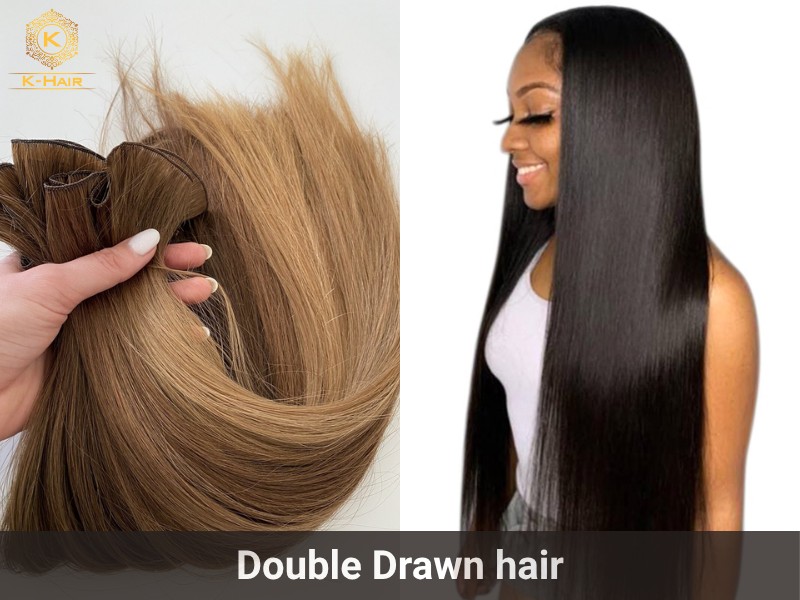
Double Drawn (DD) hair is the safest density option for most hair buyers, balancing Single Drawn’s natural look with Super Double Drawn’s thickness. With 60-70% long strands, DD hair delivers a fuller, sleek look while still keeping some natural layering. For a standard 20″ hair weft, that means roughly 65% of the bundle is genuine 20″ strands, with the remaining 35% made up of shorter lengths.
Producing Double Drawn hair takes more thorough sourcing. During combing and sorting, hair workers don’t just detangle and align cuticles – they take the extra step of combing out shorter strands to hit the correct long-strand percentage.
The result is a fuller, more voluminous bundle. Run your fingers from root to tip and you’ll feel that consistent length; bend the weft in the middle and you’ll only spot a handful of shorter strands poking through.
→ Ready to order Double Drawn stock? Browse wholesale Double Drawn hair extensions.
What is Single Drawn Hair
Next, the entry-level, most natural-looking density: Single Drawn.
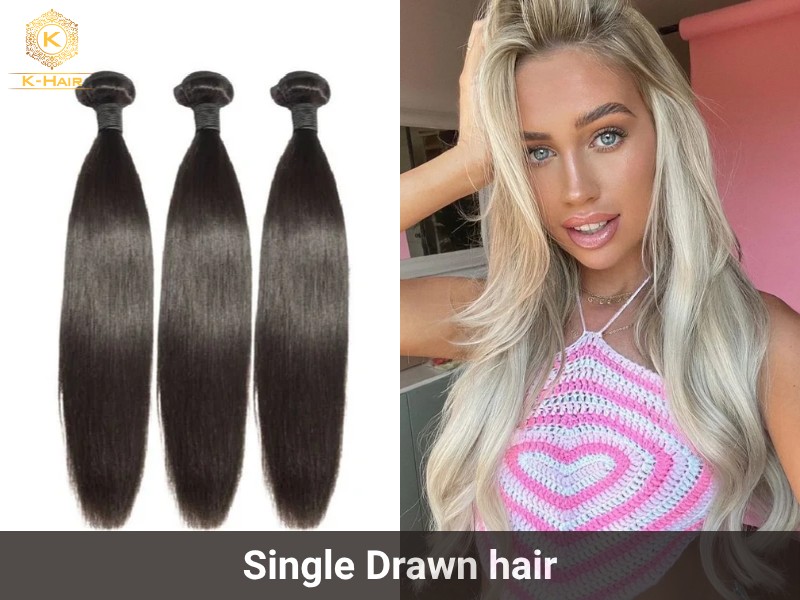
Single Drawn (SD) hair is the standard density level, with the smallest proportion of long strands of the three. Most suppliers put SD hair at 45-55% long strands. That lower ratio creates a more natural-looking effect, closely mirroring how our own hair naturally layers. On a standard 20-inch weft, roughly half would be genuine 20-inch strands, with the rest shorter.
Because it’s the default, unsorted-beyond-basics level, Single Drawn hair takes less processing to produce. Since this density closely resembles natural human hair growth, manufacturers don’t need to sort it as heavily and can use it close to as-collected.
The result is the most natural, effortless look of the three. For a layered, undone finish, stylists can use it exactly as it comes, without extra trimming.
What is Super Double Drawn Hair
Last but most searched-for: Super Double Drawn, the maximum-thickness grade.
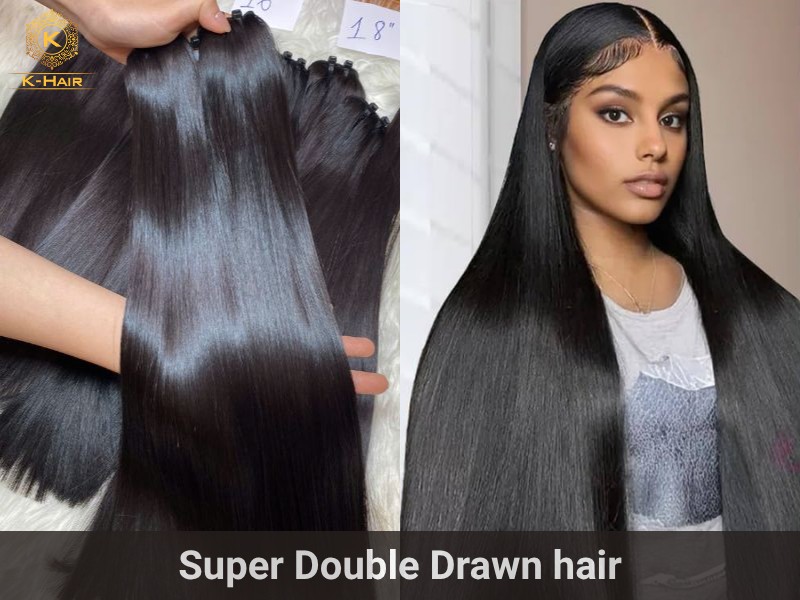
Super Double Drawn (SDD) hair delivers more fullness and volume than the other two density options combined. SDD carries the highest density on the market – 80-90% long strands – meaning only a small proportion of shorter strands remain, for maximum uniformity end to end. On a standard 20-inch weft, as little as 10-15% would be shorter, varied-length strands; the dominant 85%+ would be genuine 20-inch strands.
SDD takes considerably more labor than the other two grades. Hair workers have to pick out nearly all the shorter strands by hand, which is both more effort-intensive and limits availability – which is exactly why SDD carries the highest price tag of the three.
The payoff is a bundle that’s full from top to bottom, with consistent volume and no tapering at the ends – a thick, lustrous, blunt finish that’s become one of the most requested looks in the market, especially on wigs, closures, and frontals where an even, luxury silhouette matters most.
A few things worth knowing if you’re specifically shopping for SDD:
- SDD is not a quality grade. It describes strand-length uniformity only – not donor count, cuticle condition, or how long the hair will last. Genuine single-donor Raw hair and lower-grade multi-donor hair can both technically be sorted to SDD standard, so density alone isn’t proof of quality.
- Yes, SDD can be 100% human hair – the sorting process applies to real donor hair the same way it would to any bundle. SDD just means more of that donor hair’s natural length made it into the final bundle.
- On wigs and frontals, SDD gives a especially blunt, dense silhouette that suits short bobs and closures well. On very long lengths, that same bluntness can occasionally feel heavier or look less natural than a Single Drawn or Double Drawn taper – worth factoring in if your buyers want length over density.
Because genuine SDD hair takes so much manual sorting, it’s also the density level most likely to be misrepresented by suppliers cutting corners. Two quick checks help confirm you’re actually getting SDD-grade sorting rather than a Double Drawn bundle relabeled at a premium price:
- The bend test: Fold the weft in half at the midpoint. On genuine SDD hair, you should see almost no shorter strands poking out below the fold – if a noticeable fringe of short hairs appears, the bundle is closer to Double Drawn than true SDD.
- The tip check: Run your fingers along the very end of the weft. SDD hair should feel just as full and dense at the tips as it does near the root, with no thinning taper. A gradual thinning toward the ends is a Single or Double Drawn signature, not SDD.
Ask your supplier to confirm the exact long-strand percentage in writing, and request a sample before committing to a bulk order – the same due diligence that applies to any wholesale hair purchase applies doubly to a premium-priced grade like SDD.
Grade of Hair Extensions
Density is only one axis of what determines hair quality. Separately from SD, DD, and SDD, manufacturers also grade hair by donor count and processing – which is what actually determines cuticle health and lifespan. Here are the most common grades in the market:
- Virgin hair: positioned as the highest-quality hair on the market, prized for softness, silkiness, and performance. To qualify as Virgin, hair must come from one healthy donor and stay chemically untouched before, during, and after sourcing. That strict standard preserves the cuticle’s pristine, undamaged state. Virgin hair also allows flexible styling, can be bleached to bright blonde, and lasts more than 5 years under proper care.
- Remy hair: the more economical option, balancing quality and affordability. Remy hair comes from 2-3 donors, still free of prior chemical processing. That sourcing method improves availability while keeping softness and silkiness close to Virgin-level. Because it’s collected from multiple heads, though, cuticle alignment is slightly less uniform, making it marginally more prone to tangling. Under proper care, Remy hair still lasts 2-3 years or more, and can lift to #27.
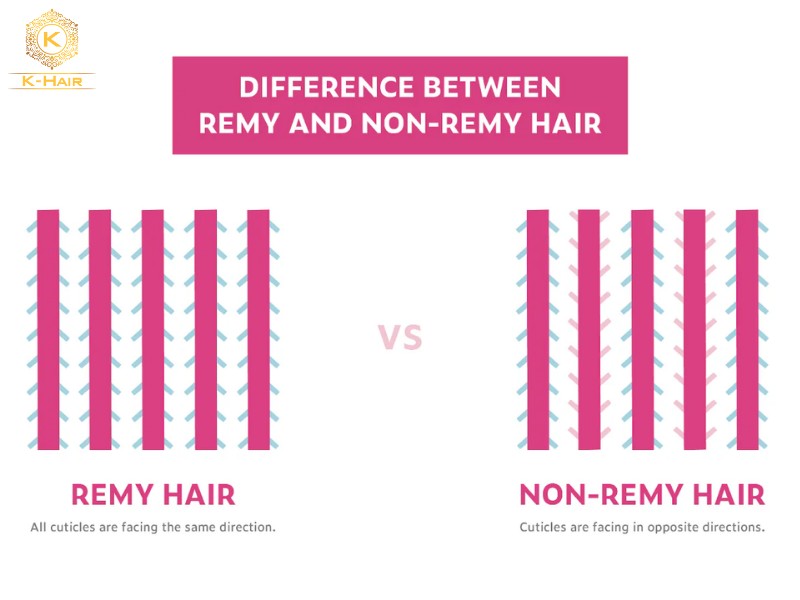
- Non-Remy hair: still technically human hair, but the lowest grade available. Unlike hair from voluntary donors, non-Remy hair is often collected from hair trash, tangled sweepings, or other unsanitary sources. That sourcing method boosts availability for manufacturers, but the hair itself is far more prone to tangling and damage, which limits styling range significantly.
- Synthetic hair: made entirely from plastic fiber to mimic human hair’s natural shine. Its stiff strands and artificial luster tend to give it away visually, and functionally it’s extremely heat-sensitive – the fiber can melt or break on contact with hot styling tools.
→ Choosing between the two most common human hair grades? See Raw hair vs Virgin hair or find out what Remy hair actually means.
Compare Single vs Double vs Super Double
Here’s how the three density levels stack up side by side:
| Single Drawn | Double Drawn | Super Double Drawn | |
| Pros |
|
|
|
| Cons |
|
|
|
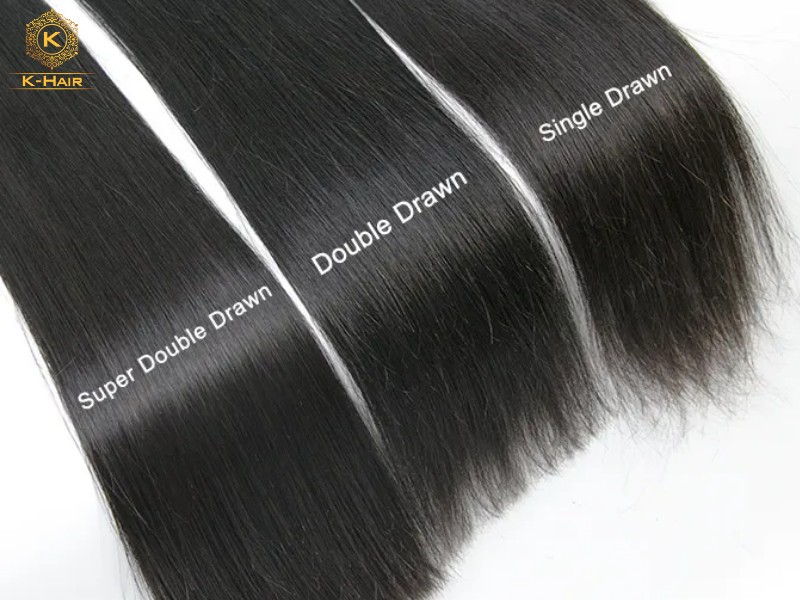
With that comparison in hand, you should have a clear picture of what separates Double Drawn, Super Double Drawn, and Single Drawn hair – and which one fits your business goals.
Price List of Single vs Double vs Super Double Hair Extensions
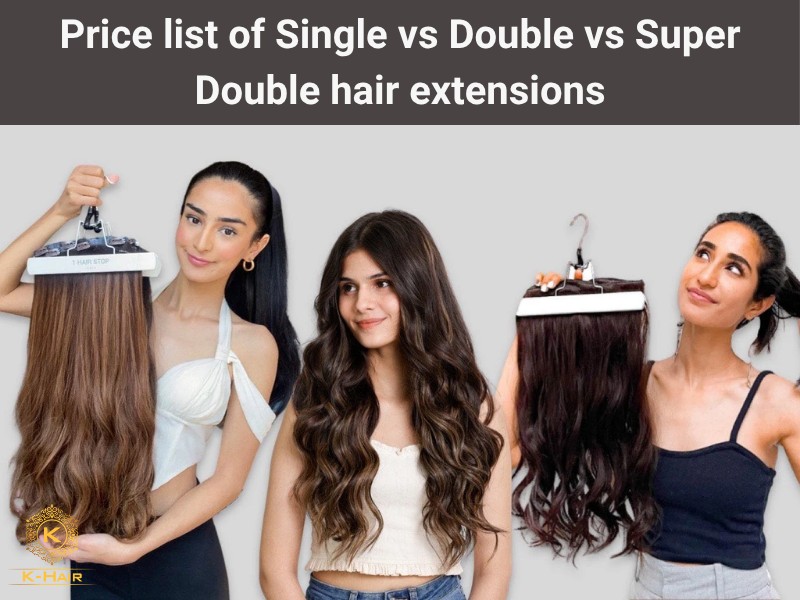
Density is one of the biggest drivers of hair pricing. The more long strands a bundle needs, the harder it is to source enough matching material – so pricing rises accordingly. Across most vendors, Single Drawn is the cheapest, Double Drawn sits in the middle, and Super Double Drawn commands the highest price.
Below is current wholesale pricing (Natural Straight, Natural Color, per 100g bundle):
| Length | Single Drawn | Double Drawn | Super Double Drawn |
| 8″ | $17.30 | $19.40 | $23.70 |
| 16″ | $34.80 | $42.90 | $46.40 |
| 24″ | $62.70 | $64.90 | $81.90 |
| 30″ | $73.70 | $93.30 | $104.30 |
→ Need pricing at every 2-inch increment, or for Bone Straight and Curly textures? See the full Vietnam hair factory wholesale price list, or check the hair extension length chart for sizing guidance.
| Single Drawn | Double Drawn | Super Double Drawn | |
| Suitable for |
|
|
|
K-Hair: Best Factory to Order Double, Single, Super Drawn Hair Extensions
K-Hair Factory is one of the most trusted, long-established Vietnamese hair manufacturers, earning global recognition for authentic, high-quality hair and for consistent quality, transparency, and professionalism throughout every transaction.
Among suppliers in the field, K-Hair stands out for 100% Vietnamese human hair, known for natural shine, softness, and durability. Every bundle is ethically collected from healthy Vietnamese donors and processed with minimal chemical exposure to preserve natural strength and flexibility – meaning it can be dyed, bleached, and styled freely without shedding or tangling. K-Hair also offers all three density levels covered in this guide, so whether you’re shopping SD, DD, or SDD, you’re working with one reliable supplier.
Another core strength is K-Hair’s direct production model. Hands-on involvement at every stage – from raw hair sourcing through to production – keeps quality control strict while cutting unnecessary external costs, which translates to more competitive pricing without sacrificing consistency.
Beyond the product itself, K-Hair focuses on customer experience: clear communication, secure payment methods, and dependable support from first consultation through shipping and after-sales care. A growing presence in key markets like Nigeria, Brazil, and the United States backs up that reputation with real, ongoing business partnerships.
For buyers still deciding between density levels, our team can also walk through sample options across SD, DD, and SDD before you commit to a bulk order – so you’re not guessing which grade will actually match what your end customers expect.
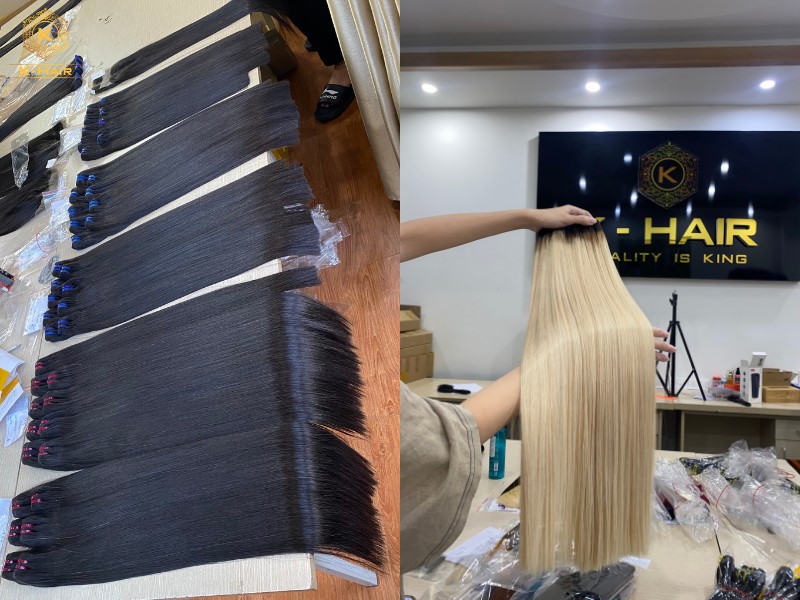
For many international buyers, K-Hair isn’t just a Vietnamese hair supplier – it’s a trusted partner dedicated to helping their business grow through quality, reliability, and integrity.
→ Want a visual breakdown of SD, DD, and SDD side by side? Watch: Vietnamese Hair Factory FREE LIST: BEST Hair Vendors.
FAQs About SD, DD, and SDD Hair
A few questions come up again and again once buyers start comparing density levels – here are quick, straight answers to the most common ones.
Is SDD hair human hair?
Yes, on its own SDD only describes how strands are sorted by length – it says nothing about whether the hair is human or synthetic. Reputable suppliers apply SDD sorting to genuine donor hair, but the term alone isn’t proof of origin, so always confirm donor count and processing separately.
Is SDD hair good?
SDD is good if what you’re after is maximum thickness and a blunt, uniform finish – it’s not automatically “better” hair in terms of health or lifespan. A well-sourced Single Drawn bundle from a reputable factory can outlast a poorly-sourced SDD bundle from an unverified vendor.
What does SDD mean on a wig or frontal?
Same meaning as on a bundle: roughly 80-90% of the strands are the same length. On wigs and frontals specifically, that translates to a dense, blunt-cut look with no wispy ends – popular for short bobs and closures, though it can look less natural on very long styles.
What’s the difference between DD and SDD hair?
Percentage of uniform-length strands. Double Drawn runs 60-70% long strands with some natural taper still visible; Super Double Drawn runs 80-90%+, with almost no taper and a noticeably higher price due to the extra sorting labor involved.
SDD or DD hair – which one is better?
Neither is objectively better – they’re built for different results. DD is the more versatile, budget-friendlier middle ground that works across textures and suits buyers who aren’t sure yet what their customers will ask for. SDD is the right call specifically when a buyer wants maximum blunt thickness and is willing to pay a premium for it. For a first wholesale order, most businesses start with DD and add SDD to the catalog once they know their customer base wants it.
Conclusion
With the breakdown above, you should have a clear picture of the difference between Single Drawn, Double Drawn, and Super Double Drawn hair – and which grade is the right call for your wholesale orders and your customers.
Building a successful hair business takes more than good products – it takes a supplier who genuinely supports your growth. At K-Hair Factory, we’re proud to stand behind every order, every shipment, and every wholesale buyer who trusts us with their business.
Whether you’re ordering DD bundles for premium clients or SD for everyday volume, we supply all three grades directly from our factory in Hanoi, with consistent quality, factory-direct pricing, and fast international shipping to Nigeria, the USA, the UK, South Africa, and 50+ countries worldwide.
Ready to source verified raw Vietnamese hair?
Contact K-Hair Factory directly for wholesale pricing, MOQ details, and free samples.


Pingback: Apo Hair Review: Quality, Pricing, and MOQ Explained
Pingback: Ponytail Hair Extensions: A Wholesale Buyer's Guide