
With all the progress made in the hair and beauty industry, more and more diverse types of hair extensions are introduced to the market. Although this is a positive development, as the category is now better catered to a wider audience, hair businesses might find it hard to differentiate and pick out the most suitable for their brand. This task is especially difficult for those with no prior experience in the field.
Despite the various kinds, if well-informed, anyone can distinguish and decide on the most profitable category for their business. And this is exactly what we are here for.
1. What Are Hair Extensions?
Before getting into different types of hair extensions, we should first start with the ground work – defining what they are. And simple enough, these extensions can be defined as hair enhancements, used to add volume, length, and highlight colors to your hair.
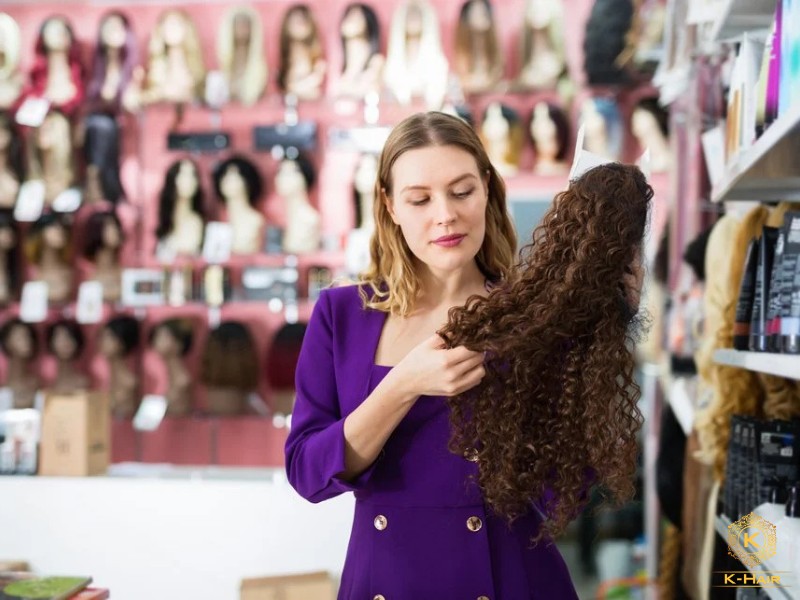
Business wise, hair extension is indeed a worthwhile investment field. According to Grand View Research, in 2025, the hair extension market alone has made more than 7.7 billions of dollars in revenue. This secures quite a bright future for all hair businesses out there.
In fact, participating in this blooming market can land you various benefits:
- Huge market demands: As living quality is improved for many regions, hair, beauty and other aesthetics needs are now paid more attention to. This opens up more sales opportunities and ultimately, wider profit margins for hair entrepreneurs.
- Recurring revenue: Hair extensions are not permanent – in fact, they require repurchasing and reinstallation. Hence, for businesses, this can lead to recurring sales, multiplying one’s profit.
- Rising popularity: With the rise of social media, more and more people are now more drawn to hair extensions, wanting to achieve glam looks seen on celebrities. This also further exaggerates the product line’s popularity and profitability.
- Multiple sales channels: In today’s world, there are numerous ways for hair businesses to reach their clients – e-commerce, websites, social media,… This further expands your multi-channel customer base → ultimately leads to more sales and brand reach.

Hair extensions’ rising popularity and market demands are some of its advantages
2. Different Hair Materials On The Market
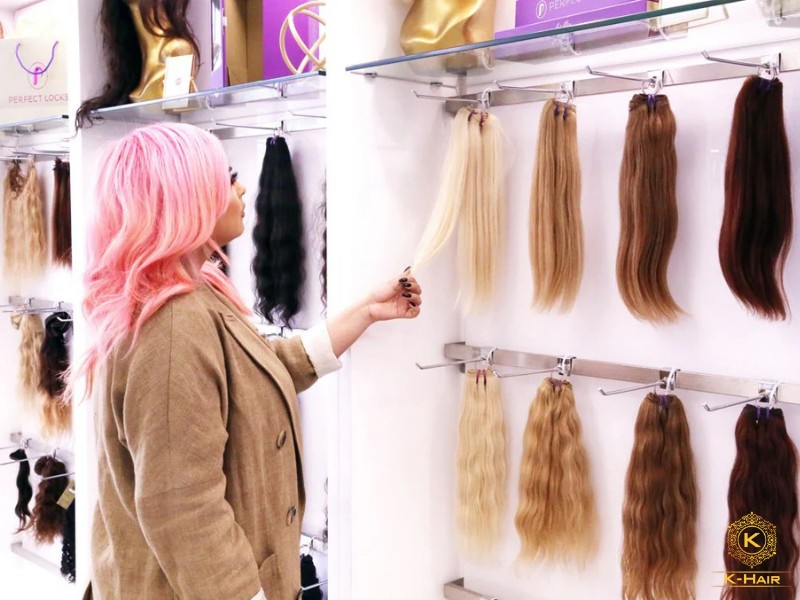
Based on varied preferences and budget, hair manufacturers offer two different hair materials for their buyers – human hair and synthetic hair:
- Human hair extensions: Much like its name, these are types of hair extensions collected from authentic human hair. As a result, they can still carry many desirable traits seen in our own hair, such as silkiness, softness, durability and lifespan.
- Virgin hair: The highest quality of human hair – Virgin hair is strictly collected from one donor only, guaranteeing the best durability and cuticle alignment. It can be bleached to bright blonde #613, and be kept for more than 5 years.
- Remy hair: The more affordable version of Virgin hair, Remy hair is collected from 2-3 donors, making it slightly more prone to tangling. It can be bleached to honey blonde #27 and be kept for 2-3+ years.
- Synthetic hair extensions: Unlike human hair, synthetic hair is made strictly from synthetic, plastic-based material, designed to look similar to human hair. Therefore, it can still look, or reflect light the similar way, but it cannot be styled, or last as long as authentic human hair.
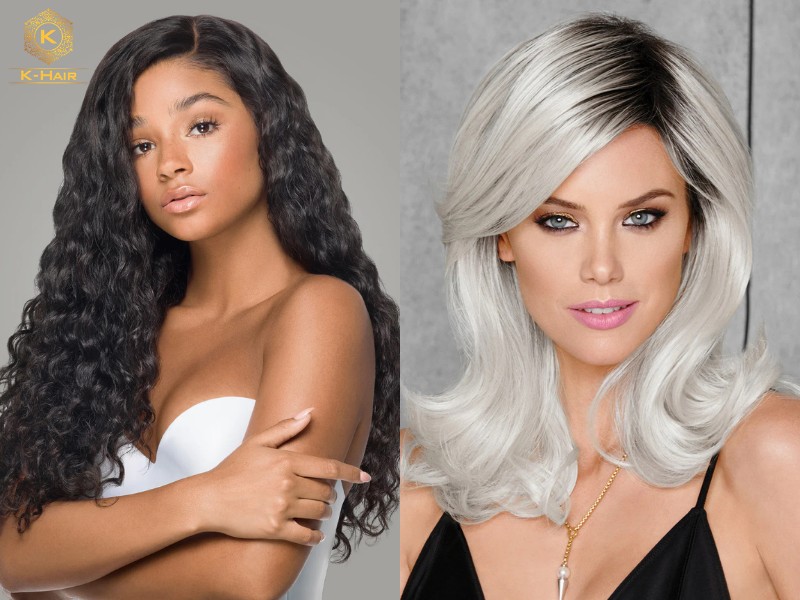
Human hair and Synthetic hair
Depending on your targeted audience, it is crucial to pick out the suitable hair material and types of hair extensions for their preferences and spending ability. However, as the market grows to be more and more picky on hair quality and performance, it is best to go with high-quality, authentic human hair. In 2025, more than 65% of the total market revenue belonged to human hair extensions – showcasing its popularity over synthetic ones.
3. Different Types of Hair Extensions
In this part of the article, let’s delve deeper into the world of extensions, and differentiate various types of hair extensions available on the market:
3.1 Hair Wefts (Sew-in Hair Extensions)
This is one of the most common types of hair extensions on the market.
By definition, hair wefts, hair bundles, or sew-in extensions all refer to the same type: hair strands sewn together into a strip and folded into a bundle. In the market, there are currently three main hair weft sub-types: Machine Wefts, Genius Wefts, and Hand-tied wefts.
- Machine wefts are especially popular among African Americans, as they are often used in their traditional sew-in method. In this method, the wefts will be sewn on top of tight hair braids. → Suitable for brands targeting this specific customer base.
- On top of that, the advanced Genius wefts can also be made into other products – tape-ins, clip-ins, wigs,… → Suitable for custom unit designers, or wig makers,…
- Hand-tied wefts, on the other hand, are the ideal product line for Caucasian hair buyers – thanks to their ultra-thin, flat wefts,…
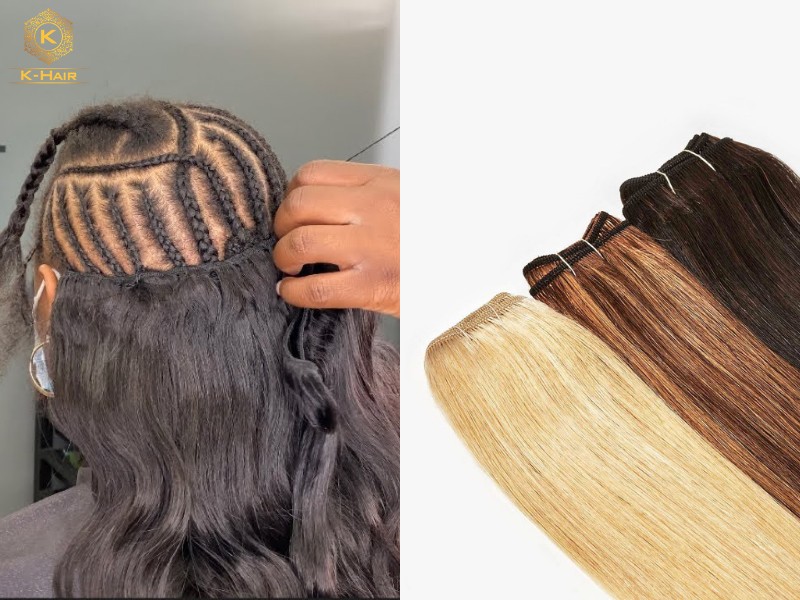
→ Through the insights above, we can easily conclude that – the ability to cater to a wide range of hair markets is a major perk for businesses selling hair wefts. In reality, hair wefts are in favour of many buyers in the market, thanks to its long-lasting lifespan, durability and affordability.
Hair wefts are also the universal category that a huge proportion of hair businesses have – make sure to learn more about Hair weft extensions to grasp this market.
3.2 Clip-in Extensions
According to Fortune Business Insight, clip-ins are the most popular types of hair extensions out there – accounting for 40% of the total revenue. This makes the product line one of the most potential hair investments for businesses.
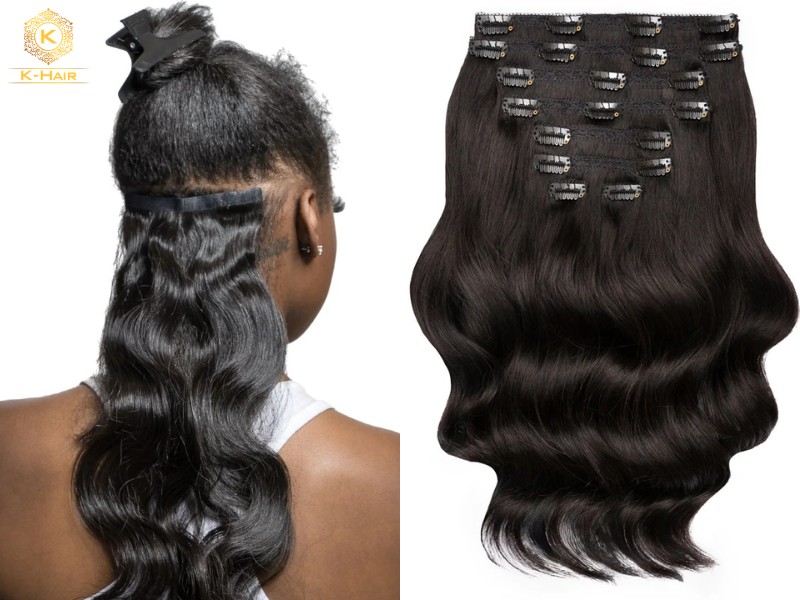
By definition, clip-ins are small hair wefts, with small hair clips sewn or glued at the root of the hair piece. These hair clips hence allow fast installation – most clip-ins only take around seconds to be applied on the user’s hair.
This creates a huge perk for clip-ins, making it a convenient and user-friendly kind of hair extensions that can be used daily – extremely suitable for today’s busy lifestyle. What’s more is that the fast installation also allows its users to switch style flexibly, meeting the diverse hair demands among buyers. However, its pricing, as well as its inferior blending ability can be some popular problems for hair salons providing clip-ins to their customers.
3.3 Tape-in Extensions
What clip-ins lack, tape-ins make up for, especially in blending ability.
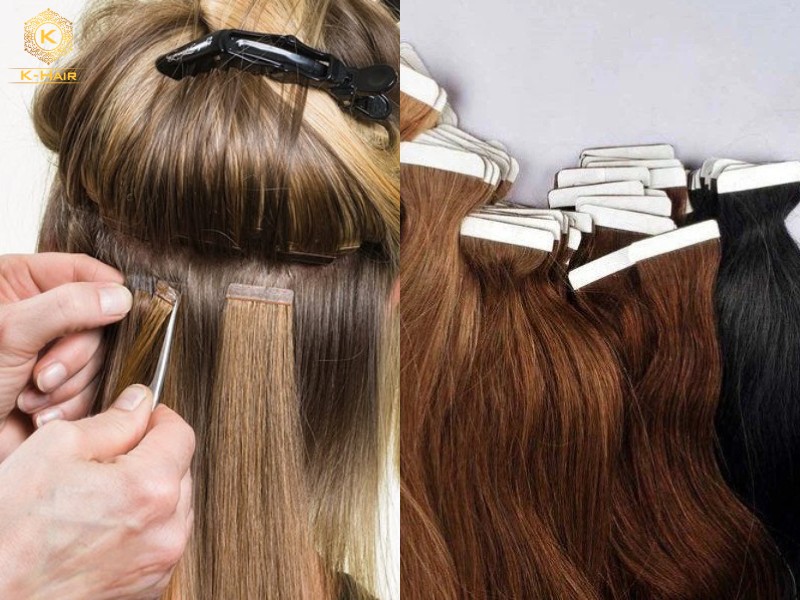
By definition, tape-ins consist of tiny and flat hair wefts, with a small strip of double-sided tape at the root. As small and lightweight as they are, tape-ins are mostly sold in batches of 100gr, which means 20-40 pieces/set.
Unlike most types of hair extensions, tape-ins are DIY-able, meaning that the user can apply the hair piece themselves without depending on professional help. In fact, the steps are simply to get rid of the tape seal, and attach it next to your natural hair line. On the average, its installation can last up to 2 months, with proper care.
Besides being DIY-able, tape-ins are also reusable and natural-looking – making it highly in-demand and profitable. However, its high maintenance can slightly affect the user’s experience and customer reviews. But, it is not necessarily a disadvantage, as stores and salons can still couple them up with hair care products to ensure better satisfactions.
3.4 Keratin Bond Extensions
Among the types of hair extensions available on the market, keratin bond extensions, or K-tips, are among the most popular options, especially for salons and stylists.
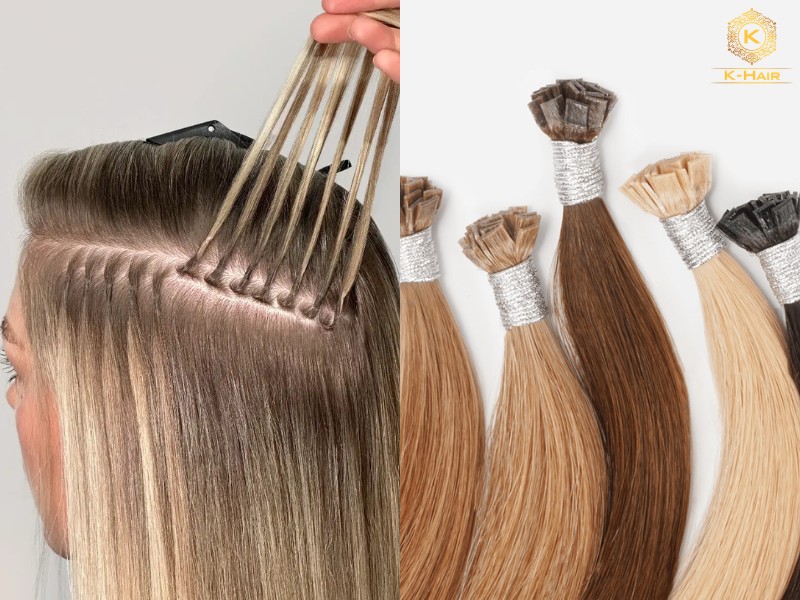
By definition, keratin bond extensions are small, extremely lightweight hair pieces, often with a keratin bonded head for each piece. In the market, they are sold in packs of 20-50 pieces, with variations like U-tips, V-tips, Flattips,…
Keratin bond extensions are dependent on professional installation, as their keratin must be melted using tools in order for the hair piece to be attached to the user’s natural hair. In exchange, the installation results in a seamless, natural-looking and long-lasting hair look that lasts more than 3-6 months.
However, salon professionals should be extra careful when using these on your customers, especially those with thin, damaged hair. Indeed, the heat used in the process is likely to burn and cause more heat damage to the fragile strands.
3.5 I-Tip Extensions (Nanoring Extensions)
Much like keratin bond extensions, I-tip extensions are also widely used in salon surroundings.
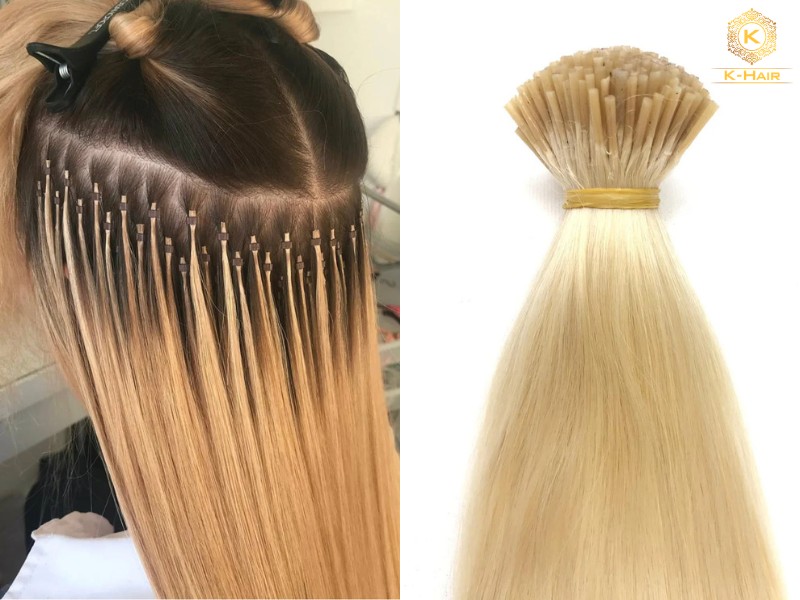
I-tip extensions are considered quite similar to keratin bond extensions. They also have a keratin bonded head for each piece, and also sold in packs of 20-50 pieces. However, much like its name, I-tips keratin heads are cylinder-shaped, instead of having various tip shapes like the K-tips.
Unlike keratin bond extensions attached using heat, I-tips are tied to your hair using nano rings or plastic tubes → making it completely non-damaging and hair-safe, without risking its blending ability. Not only that, this installation method also allows the hair piece to be reusable. Each I-tip installation can last 3-6 months or more, making it one of the most in-demand salon extensions out there.
3.6 Halo Extensions
If you are interested in temporary types of hair extensions, but hesitant with the thought of clip-ins and its bumpy looks – Halo extensions is the way to go!
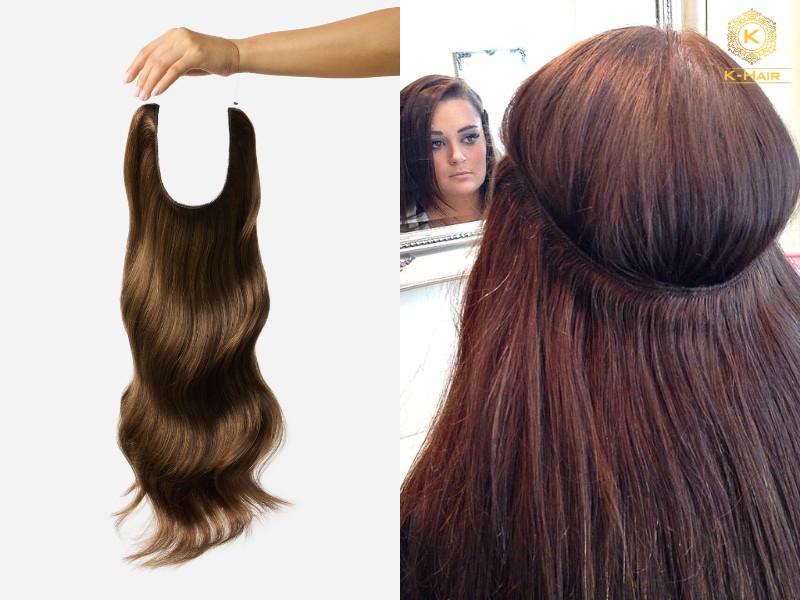
Unlike clip-ins with hair clips, halo extensions are attached to the user’s hair line using an invisible wire (or halo wire). This wire can be tied and rested around your head perimeter like a headband – with natural hair overlaying on top of them for a seamless finish.
In fact, this installation is not only time-efficient, but also user friendly – perfect as a ready-to-wear product line for brands and stores to offer to modern hair buyers. On top of that, this extension line is still relatively new in the market – meaning a niche market segment with unexploited potentials.
3.7 Ponytail Extensions
Similarly, ponytail hair extensions are also among the ready-to-wear types of hair extensions, with a non-damaging attachment method.
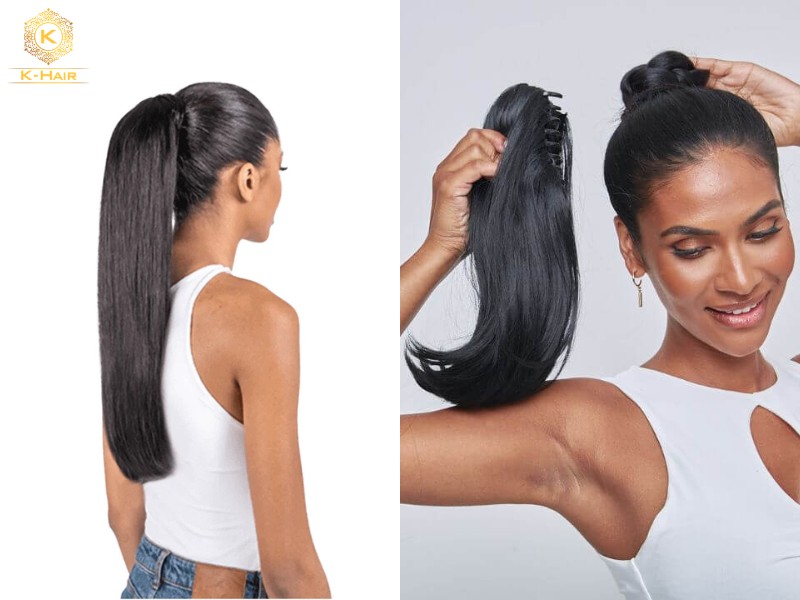
By definition, much like their name, ponytail extensions are designed to give instant volume, length boost to your user’s ponytail. And based on attachment method, they can be further divided into 3 subtypes:
- Wrap-around: featuring a small hair clip with a Velcro strip and an extra hair strand that wrap around the base of your ponytail for better concealment.
- Drawstring: featuring a small cap and a drawstring – adjustable for better attachment.
- Claw-clip: featuring a claw-clip – can be attached on top of the user’s hair bun or ponytail.
Business wise, ponytail extensions can be quite a money-earner, especially for product-centered businesses like supply stores, hair brands. This product line can indeed promise higher sales, especially from customers wanting quick installation and DIY-able extensions. However, as this line is only available in a selective style range – ponytails, they are not optimal as a versatile type of extensions.
To summarize the differences between varied types of hair extensions out there, let’s take a look at this table below:
| Installation Lifespan | Maintenance | Pricing range | |
| Hair wefts | 1-2 months | Moderate maintenance | From $20 to $115/piece |
| Clip-ins | Daily installation | Low maintenance | From $25 to $123/piece |
| Tape-ins | 1-2 months | High maintenance | From $25 to $115 |
| Keratin bond extensions | 3-6 months | High maintenance | From $25 to $115 |
| I-Tips extensions | |||
| Halo extensions | Daily installation | Low to Medium | From $30 to $70 |
| Ponytail extensions | Daily installation | Low to Medium | From $20 to $200+ |
Internal Tips: Besides hair extensions, your business should also include Wigs to cater to a wider customer base.
4. K-Hair – The BEST Vietnam Hair Suppliers for All Types of Hair Extensions
First originated in the late 2010s, K-Hair has now blossomed into one of the biggest hair factories in Vietnam. If our journey can be described by 3 words, they would be Quality, Consistency, and Professionalism.
- Quality is King has always been our motto. Clients coming to us can be more than assured of the hair quality we provide – since we only collect hair from authentic Vietnamese donors, process it without using any chemicals.
- Consistency is how we have been able to maintain our commitments throughout 15 years of development. Over time, as we scale up our business, we have remained steady in delivering reliable hair quality, competitive pricing → making ourselves a reliable destination for all hair businesses out there.
- Professionalism is reflected through our customer support, with fast reply rate, effective communication, and fast consultation despite time zone differences.
K-Hair – The BEST Vietnam Hair Suppliers for All Types of Hair Extensions
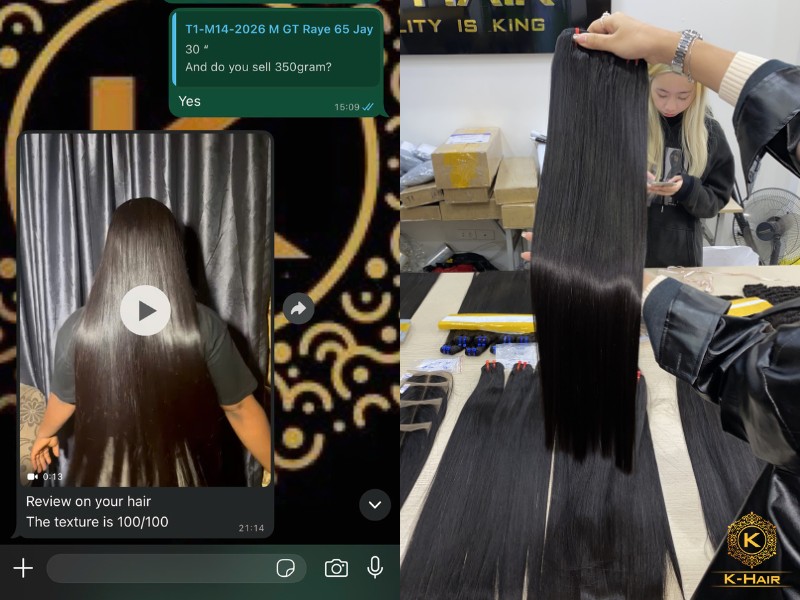
As a hair businessperson myself, I know for a fact that offering a diverse range of hair extensions is one way to ensure your brand’s survival. And finding a reliable hair vendor is rarely a simple task, given how many scammers are out there. For hair businesses wanting a trusted partner, K-Hair, with our commitment to Quality, Consistency, and Professionalism, is your best match as one of the best hair supplier in the world.
5. FAQs about Different Types of Hair Extensions
Here are some frequently asked questions about types of hair extensions:
5.1 What are the main types of hair extensions?
The most common types include:
- Clip-in extensions
- Tape-in extensions
- Sew-in (hair weft, bundle, or weave) extensions
- I-Tip (Nano ring) extensions
- Keratin bond extensions
Each type differs in installation method, longevity, maintenance, and suitability for different hair types.
5.2 Which types of hair extensions are best for thin hair?
Tape-in and hand-tied sew-in are types of hair extensions often recommended for fine or thin hair because they lie flat against the scalp and distribute weight evenly. Proper installation is essential to avoid tension or visibility.
5.3 What’s the difference between human hair and synthetic types of hair extensions?
Human hair extensions:
- Can be heat styled
- Can usually be dyed
- Look more natural
- Last longer
Synthetic extensions:
- Are more affordable
- Cannot handle high heat
- Typically have a shorter lifespan
For long-term wear, 100% human hair is usually the preferred choice.
5.4 Can you wash and style all types of hair extensions?
Most human hair extensions can be washed, blow-dried, and styled with heat tools. However, clip-ins should be removed before sleeping, and some methods (like keratin bond extensions) require extra care around the attachment points.
5.5 Which type of hair extensions is best for beginners?
Clip-in extensions are typically best for beginners because they:
- Require no professional installation
- Can be applied and removed at home
- Cause minimal long-term commitment
They are ideal for occasional volume or length.
6. Conclusion
Types of hair extensions represent more than just styling choices – they shape how salons build services, attract clients, and position their brand in the market. Selecting the right methods for your audience can directly impact customer trust, retention, and long-term growth.
We hope this article has clarified the key differences and given you more confidence in selecting the right options for your business. Now, all you need is a reliable supplier who can deliver consistent, high-quality hair across every extension type, and K-Hair – one of the best Vietnamese hair factory is ready to be your long-term partner in that journey.
Interested in hair extensions?
- Order a sample of K-Hair products – look what we have to offer and see the quality for yourself.
- Ready to source premium hair? [Contact our experts today] through hotline: +84 85 333 0244 or visit our Facebook: K-Hair Vietnam Factory to get the latest wholesale price list and start building your brand with confidence!


Pingback: Hair Extensions Sydney - Top 5 B2B Wholesale Suppliers
Pingback: How to Install Clip-In Hair Extensions: A Step-by-Step Guide
Pingback: Halo Hair Extensions: A Complete Buying & Care Guide
Pingback: Vietnamese Hair Factory: Top 8 Picks for Your Salon in 2026