
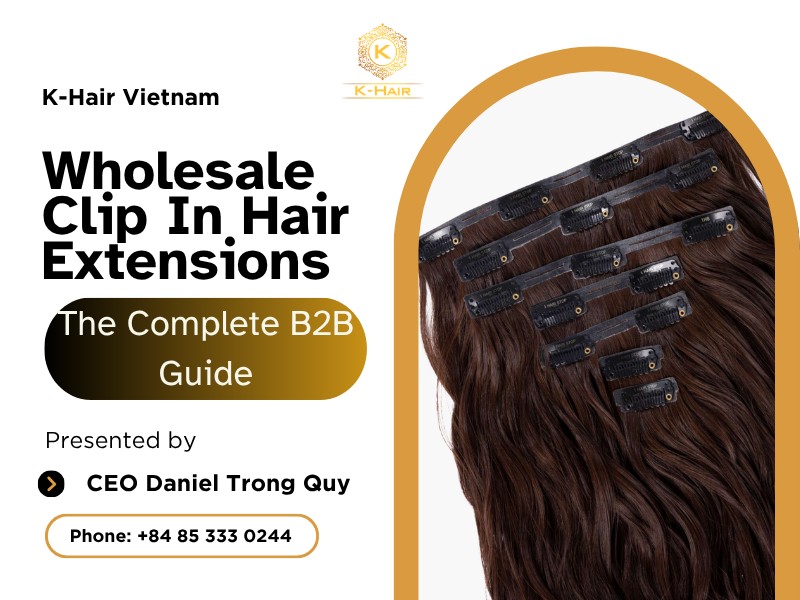
Buyers are shifting away from semi-permanent extensions with lengthy installs. Instead, wholesale clip in hair extensions dominate the market because they let end-users add length or volume in minutes without a salon visit.
For salons and retail supply stores, this shift is a real revenue opportunity, but only if you adapt your catalog accordingly. This guide breaks down the market, the specs to check, the sourcing decisions, and how to price wholesale clip in hair extensions correctly for a US or EU retail audience.
An Overview of The Global Wholesale Clip In Hair Extensions Market
Wholesale clip in hair extensions are pre-attached hair wefts fitted with pressure clips that snap directly onto natural hair. Installation takes 2-3 minutes with no bonding, glue, or heat tools required, which is why clip ins are considered the fastest hair extension category to retail.
The US remains the single largest buyer market for wholesale clip in hair extensions, followed by the UK and Western Europe, where demand skews toward natural-looking, lightweight sets under 160g. Growth in this category has consistently outpaced tape-ins and sew-in wefts over the past several years, largely because clip ins require zero certified skill to install or remove.
→ Explore the full range: Clip-in hair extensions collection
The Popularity of Wholesale Clip In Hair Extensions
According to a recent market review from Grand View Research, wholesale clip in hair extensions alone account for nearly 40% of global hair extension revenue, ranking above wefts, toppers, and tape-ins. Several factors are driving this shift:
- Market Availability: Growth in global hair manufacturing and e-commerce has made clip ins more accessible to the mass market.
- Time-Saving Convenience: Busy consumers have less tolerance for lengthy, demanding installations and maintenance routines.
- Health Priorities: Clients with alopecia, thinning hair, or sensitive scalps rely on clip ins as a lightweight, zero-damage protective style.
What Can You Get For Selling Wholesale Clip In Hair Extensions?
From a sourcing expert’s perspective, wholesale clip in hair extensions rank among the most profitable product lines a retailer can stock:
- Ultra-Low Operational Barriers: No certified training is required for clip in installations, which cuts staff training costs and lowers return rates from beginner users.
- Retail Upselling Opportunities: Sellers boost average order value by bundling clip ins with brushes, storage bags, and shampoos.
- Capitalizing on Modern Consumer Trends: Distributors can charge a premium for the convenience and flexibility clip ins offer over semi-permanent extensions.
- Social Media Appeal: The instant volume transformation makes clip ins highly shareable content, turning video views into rapid sales among younger buyers.
Wholesale Clip In Hair Extensions – Product Specifications
Not every clip in variation performs the same in sales. Manufacturers have diversified their offerings across material, weft, density, and texture to serve different price points and markets.
Human Clip In Hair Extensions vs Synthetic Blends
Buyers sourcing wholesale clip in hair extensions must choose between human hair and synthetic blends:
- Clip in hair extensions human hair: made from authentic human hair, split into three tiers:
- Raw human hair clip in hair extensions: single-donor hair with 100% cuticle alignment. Tangle-free, can be bleached to #613 or #60, lasting 4-5+ years under proper care.
- Remy hair extension clip ins: collected from 2-3 donors with slightly varied cuticle direction. Soft and tangle-resistant, can be bleached to #27, lasting 2-3+ years. See the full breakdown of Remy hair vs virgin hair before you order a sample.
- Non-Remy clip ins: multi-donor hair coated with silicone, minimal cuticle alignment. Budget-friendly but prone to tangling and cannot be bleached without structural damage.
- Synthetic clip in extensions: made from artificial fiber, so they cannot be colored, bleached, or heat-styled. Cheap and available in vibrant shades, but last only 6-12 months. Compare the trade-offs in our Synthetic hair vs human hair guide.
Human hair takes up to 75% of total wholesale clip in hair extensions sales.
| Human Hair | Synthetic Blends |
|---|---|
| Takes full-head styling and bleaching. Lasts years with proper care. Blends naturally with natural hair. A suitable long-term, premium investment. | Melts at low heat, making texturizing impossible. Shiny, fixed look with unnatural blending. Shorter lifespan, ideal only for temporary wear. |
Weight & Density: The Spec Most Buyers Overlook
Density is the single biggest factor separating a thin, obviously-fake set from a full, natural one, and it is the spec most first-time wholesale buyers forget to ask about. Wholesale clip in hair extensions typically ship at 120% to 200% density, and factories express this as a ratio between the weight of the hair and the weft length it is sewn onto.
- 120% density: the lightest tier, usually 100g to 120g per full set. Best suited for buyers targeting thin or fine natural hair, where a heavier set would look bulky at the root.
- 150% density: the most commonly stocked mid-tier, around 140g to 160g per set. This is the safest default for a general retail catalog since it fits most hair types.
- 200% density: the fullest tier, 180g to 200g+ per set, aimed at buyers who want maximum volume or are working with thick natural hair.
Set configuration also varies by piece count: a standard full-head set runs 7 to 10 pieces per pack, with wider pieces (8″ clips) used for the crown and back, and narrower pieces (1″-2″ clips) for the sides. Listing density and piece count clearly on your product pages helps reduce return rates from buyers who expected more fullness than they received.
Factories usually quote density as a range rather than a fixed number, since raw hair batches vary slightly in thickness even within the same donor grade. Ask your supplier for a tolerance range (for example, 150% ± 10%) in the spec sheet, and request a weighed sample set before confirming a bulk production order.
Wholesale Clip In Hair Extensions – Weft Specification
Weft quality is one of the top reasons clip ins get returned. Know which weft specification fits your target audience:
- Standard weft: strands sewn into a fabric strip. Durable, shedding-free, and easy to repair. Cheaper pricing suits budget-conscious buyers who prioritize longevity.
- Invisible PU weft: strands bonded into a thin polyurethane strip for a seamless, invisible blend. This premium line is popular with high-end salons and demanding, high-income clientele.
Clip count matters as much as weft type. Wider pieces typically carry 4 to 6 clips for a secure hold on the crown, while side pieces use 1 to 2 clips. Cheaper factories cut costs with thin, low-snap-force clips that pop open under normal movement, so ask suppliers for the exact clip brand and snap-force rating before placing a bulk order.
What Are The Best Selling Clip In Hair Extensions?
Not every wholesale clip in hair extensions variant sells equally. From a sourcing expert’s viewpoint, the most popular choices are textures and colors closest to a buyer’s natural hair, since most clip in users are busy professionals seeking a natural look.
The best selling wholesale clip in hair extensions include:
- Natural Straight Clip-in hair extensions – best match for straight hair types.
- Loose Wavy, Natural Wavy clip in hair extensions – best match for wavy hair types.
- Kinky Curly, Deep Wave, Italian Wave – for curlier hair types.
- Natural black, bright blonde, honey blonde, and light brown shades.
By length, 18″ to 22″ sets sell fastest for retail catalogs since they suit the widest range of customers, while 24″+ sets see seasonal spikes around prom and holiday periods when buyers want a dramatic, one-time transformation.
Beyond full-head sets, buyers should also stock a smaller side-piece SKU (1-2 clips, 20g-30g) for customers who only need extra fullness at the crown or temples rather than a full-head install. This lower price point is often the entry SKU that converts a first-time visitor into a repeat wholesale customer, since it carries less risk than committing to a full set.
Where To Buy Clip In Hair Extensions – Vendor Verification
With so many wholesale clip in hair extensions suppliers on the market, the right criteria help you cut through the noise and find the right manufacturing partner.
Based on Production Capability
Production capacity is the ultimate test of a reliable wholesale partner. A supplier’s output, technical expertise, and quality control directly determine how well they support your business as it scales:
- Product availability: guaranteed stock levels, even during peak season, so bulk orders don’t face sudden delays.
- Product diversity: a wide range of textures, colors, lengths, and customization options for niche shade matching.
- Quality consistency: strict quality control across batches ensures cuticle alignment, double-drawn fullness, and clip durability.
OEM/ODM & Private Label Capability
Buyers building their own hair brand should confirm a supplier’s private label capability before committing to a wholesale relationship. This typically covers three layers of customization:
- Packaging customization: custom boxes, backer cards, and hang tags printed with your brand logo instead of the factory’s generic packaging.
- Product customization (ODM): adjusting density, weft width, clip type, and color ratio to a spec sheet you provide.
- Full private label (OEM): the factory manufactures under your brand name exclusively, usually requiring a higher MOQ and a longer production lead time than stock orders.
Lead time for a private label production run is typically longer than for stock inventory, so factor this into your launch timeline if you are building a new hair brand around wholesale clip in hair extensions rather than reselling generic stock.
Based on Hair Quality
Hair quality ultimately decides customer satisfaction, so this criterion should top your vendor checklist. Use these four tests to verify a supplier’s wholesale clip in hair extensions:
- The Burn Test: ignite a few strands. 100% human hair burns to ash and emits a distinct singed-protein smell.
- The Cuticle Test: run a blade across the weft surface. Authentic single-donor hair leaves white, bright-color ash.
- The Bleaching Test: apply bleach to a section. Premium raw hair lifts evenly to #613 while retaining strength; processed hair turns patchy or gummy.
- The Washing Test: wash the sample repeatedly with sulfate-free shampoo. High-quality extensions retain luster and structure without excess shedding.
→ Full vendor checklist: How to find good hair vendors
Expert Insight: Don’t rely on the hair test videos suppliers send you. Perform these tests yourself, and start with a small sample order before committing to bulk.
Comparing Domestic US Distributors vs. Importing Direct
Sourcing locally from US distributors versus directly from international factories comes down to a classic trade-off: convenience versus margin.
| US Distributors | International Factories | |
|---|---|---|
| Pricing & Margins | Higher wholesale costs, tighter margins | Lowest factory-direct pricing, maximizes markup |
| Branding & Customization | Limited to stock textures and generic packaging | Full control over color, length, and private label |
| MOQ Requirements | Often low or no MOQ | Higher baseline MOQ to justify shipping |
| Shipping & Delivery | 1-3 business days domestic | 3-10 business days via DHL/FedEx |
Expert Insight: Clip ins target the retail end-user directly, unlike professional-grade extensions that need a certified stylist. That makes domestic distributors a poor long-term source, since they’re often your direct competitor for the same retail audience, and middlemen margins eat into your profit. Sourcing locally is fine for urgent, one-off purchases, but not for recurring wholesale clip in hair extensions orders.
How Much Are Clip In Hair Extensions?
A factory price list only tells half the story. Sourcing directly from hair factories means factoring in customs fees and import duties on top of the base rate.
Pricing Comparison: US Distributors vs International Factories
| Length | US Distributors | International Factories |
|---|---|---|
| Short (12″-16″) | $90-$250 per 100g | $40-$70 per 100g |
| Medium (18″-22″) | $270-$400+ per 100g | $50-$90 per 100g |
| Long (24″-30″+) | $300-$600+ per 100g | $70-$120 per 100g |
Local distributors charge a 50% to 80% markup over factory-direct pricing to cover convenience. Density also moves the price within each length bracket: a 200% density set can run 30% to 50% higher than a 120% density set of the same length, since it uses more raw hair per piece.
The Hidden Cost To Budget For
To build a profitable hair brand, calculate the true landed cost, not just the factory quote:
- Volumetric Freight & Packaging Overhead: couriers bill by box dimensions, not just hair weight. Backer cards, acetate boxes, and metal clips add $4-$7 per set in transit overhead.
- Import Tariffs & Customs Fees: shipments valued over $800 face formal CBP entry. Human hair carries standard import duties of 3% to 7%, plus merchandise processing fees. Check the full breakdown in how to import hair from Vietnam.
- B2C Return & Exchange Logistics: since overseas factories don’t accept single-pack returns, your brand absorbs exchange costs for color-matching mistakes. Factor a 10% retail return rate into your pricing model.
- Payment & Currency Fees: most factories require a deposit, commonly 30% upfront with the balance due before shipment, and international wire transfers carry bank fees plus currency conversion spread. Build a 1% to 3% payment-processing buffer into your landed cost calculation.
Conclusion
Wholesale clip in hair extensions remain one of the fastest-growing categories in the hair industry, driven by demand for convenience over semi-permanent installs. Winning in this category means checking density and weft specs, running the four hair-quality tests before bulk ordering, and calculating true landed cost, not just the factory quote.
If you’re ready to bypass the middleman, K-Hair Factory supplies factory-direct wholesale clip in hair extensions with full OEM/ODM customization on density, length, and packaging.
Ready to source premium Vietnamese hair?
Contact K-Hair Factory directly for wholesale pricing, MOQ details, and free samples.


Pingback: 1A Hair 101: Pin-Straight, Frizz-Resistant & Oil-Prone
Pingback: Halo Hair Extensions: A Complete Buying & Care Guide